Wednesday, September 28, 2011

Surprise!

You don't have to be able to discern the blob in the center to know what this is! No, we didn't go digging an old sonogram out of the archives. This was done just about a week ago! Yes, the Husa family is getting a surprise visit from the stork, come next April! What always amazes us is seeing the little heartbeat of this new little life for the first time!

As we anxiously await the arrival of our fourth child, we'll also need to begin making plans to come home for about four months to have the baby before returning to the field to continue much needed service in Mibu. Sometime around March thru June will be the time that we'll need to be home. There is also the possibility that we may send Shannon home earlier with the kids because of health problems she has with her pregnancies.

As this news comes as a bit of a surprise to us, we're feeling a bit less prepared than we have in the past to handle all the logistics that will be involved. Areas we could use help with include the following...

1) The biggest and most urgent need is the finances to purchase round trip airline tickets (about $10,000).
2) A working vehicle that will seat a family of six, including three car seats (A minivan perhaps).
3) Affordable housing in the Tempe/Chandler/Gilbert area - near our home church, Bethany.
4) Two cell phones we could make use of during our short stay.

Would you please join us in prayer, first as we thank God for a new little Husa on the way, but also as we ask and wait for His provision for the trip home to deliver the baby.

Thursday, September 15, 2011

Translation Consultant Workshop

The last couple weeks, we've been in Wewak, way over on the other side of Papua New Guinea, attending a Translation Consultant Workshop.

It's an interesting mix of folks who have come together from all corners of PNG (and even one from the Philippines), expressing a desire to sharpen their skills. It's interesting to think of the various backgrounds from which we all come; a carpenter, a linguist, a saleswoman, a welder, a number who became full time missionaries right out of high school, a cad drafter, an engineer, a restaurant worker by day/band member by night, and four subsistence farmers. Though our backgrounds and skill sets are so varied, all have come together with one commonality being that we love and value the power of God's word, and recognize the importance of seeing it translated clearly and accurately. From where we stand at least, bible translation is the higher calling!

The idea is to check through one of our brave peer's translation of Ephesians, using it as an exercise to hone our skills toward being able to evaluate another translation for accuracy and comprehension. We've spent a great deal of time working through the exegesis (study of what it means) of this letter, and have also been checking it with four mother-tongue speakers of the Dinangat language into which it was translated. We want to make sure not only that the translation is highly accurate, but that it is communicating clearly in a way that reflects the meaning of the original. At the end of the day, we want to know that our Dinangat brothers will understand it precisely how Paul intended it to be understood. As we do that, we hope to receive helpful criticism and understanding that will help us do our jobs better.

We're very nearly finished with the process and have been blessed to see the deep love and concern for God's word that is also obvious in these Dinangat men. It's always exciting to see others who, like the many in Mibu, care enough to sacrifice their time and leave their families for such a long time to come to this unfamiliar place so very far away from home. The prospect of sitting and being questioned by a panel of people they don't know must have been nerve wracking, but they chose to do it anyway. Definitely having overcome that fear and developed new relationships, they've been doing great and have greatly benefited their translation and us who are translating into other languages.

Monday, September 12, 2011

The Pervasion of Prominence


One thing that we often take for granted in all our communication is a little something that we call prominence. Prominence literally permeates every little bit of communication, and it simultaneously happens on multiple levels. Prominence is to blame when we understand what the main point of a paragraph is, and who or what is being referred to primarily. It's to blame for some characters being in the background while others are brought to the front of the hearer's mind. It's essential for understanding what information is backgrounded while the exhortation is highlighted. Prominence does so much more and is absolutely essential in any communication.

Did you know that the Koine Greek language has different ways of indicating prominence than English? And English has different ways of indicating prominence than the Mibu language. And the Mibu language has totally different ways of indicating prominence than Greek. And round and round it goes. Each language has its own specific ways of clearly marking prominence. A mother tongue speaker has those 'patterns' of prominence embedded in their brains so they can follow it without even thinking about it. But as soon as we cross those linguistic lines, it's a whole 'nother ball game!

Look at the attached picture. What's so funny about it? What should be the main message is actually backgrounded. And the information that should be backgrounded carries the prominence. It's silly right? But this happens more often than you realize in translation (yes, even in our beloved English translations!).

That's why we as translators need to be aware of this whole issue of prominence. How are things made prominent in the Greek text that we're translating from? How is prominence handled in the language that we're translating into? Only as we get a better understanding of this issue can we translate God's word from one language into another in a way that truly communicates.

One example would be in the story of the prodigal son. In that story, in the Greek, the way the father is introduced sets him as the main character in the story (prominence) right from the very start of the story. The way everyone else is introduced in the story sets them in the background... even the now unduly famous 'prodigal son'. In addition, at the end of the story there is a teeny tiny little marker that has a big big job of developing the author's point. It happens to set the actions of the older brother next as bringing the author's point home (another kind of prominence). He wants his hearers to understand the comparison that's being made between them and the older brother. And, of course, all throughout the story there are these little peaks and valleys of prominence that would have had the original readers keeping their focus and emphasis in the right places, shading some information as background and others as carrying the story forward.

In a translation that sticks to the form of the original, like many of our English translations, these issues of prominence aren't carried through and we end up with a sort of 'flattened' text; often difficult to discern the author's single, God inspired intent. Or even (and this actually happens in the epistles), where backgrounded information takes the front seat and an exhortation gets lost; just like in our picture here.

So back to our example, when we translate this story into the Mibu language, we need to be aware of the ways that the Mibu language uses to show the main character as the main character and the ways that it keeps the other characters in the background. We also need to be aware of the forms the Mibu language uses to drive the point home. In the Mibu language, using these forms correctly will result in a text looks very different than the Greek form, but very intentionally carries the overall meaning much more closely to what the author originally intended.

Saturday, September 3, 2011

Information overload!

After the recent church evaluation, our family left Mibu and started a 2 week long course called the Advanced Language Workshop. We're just about finished with it at this point and my brain is feeling overloaded! Don't get me wrong. The information is GREAT! It's just that it's a LOT!

To learn about the deeper levels of how a language works we...

Break texts down into propositions on a chart.
Chart out all the grammatical features of each proposition.
Chart out all the semantic features of the text.
Note the hierarchical organization of the pieces of the text.
Review the chart trying to discover the patterns the language uses to communicate.

That's the chart. The chart is the tool. But then we need the knowledge for how to use it. That's the part that leaves our heads spinning at the end of the day! You see, each language has it's own specific way of doing things like helping the hearer keep track of what or who the speaker/writer is talking about and to keep track of what is important versus what is just background info. Each language handles the breaking up of information into 'chunks' as well as relating all those chunks together in different ways. And to complicate things even further, each speaker/writer has at least a subconscious awareness of shared knowledge and experience with the recipients of their message. All this (and much more than I could possibly write about here) comes together to determine a very specific combination of sounds, words, phrases, sentences, and paragraphs, all structured and related to each other in ways that are fully capable of communicating just what the author intended. This is true of every single piece of communication that has ever left the lips of one's mouth or otherwise been penned. In fact, the only time these principles of communication are violated, one quickly concludes that the author suffers schizophrenic!

These principles are true for every language on planet earth (even the dead ones).

Learning these things gives us insight into the nature of human communication (and even how God created us to process information). Awareness of them is hugely beneficial to better understanding of how the language works into which we desire to translate God's precious word. They also help us grow further in our understanding and conviction of just what God intended to be communicated to us in the original language that his word was inspired to be written.

At this point, we've had this crammed into our heads with just a kick off in the application of it. My head hurts!

Why spend all this money (yeah, it costs!) and time to try to learn this stuff better? Is it so we can feel smarter? Is it so we have an excuse to buy more aspirin for our headaches? Is it so that we can get so into it that the thoughts of communication patterns keeps us awake at night because we just can't let it go? Nope. Nope. And nope. We do it because Jesus did it. That's right, by being born an actual human baby and being raised as part of a specific people, culture and language, these things became so much a part of him (in the unique patterns of his mother-tongue) that they all happened in his communication to people without him even having to think about it; just like we do with our own mother-tongue. Jesus communicated to people in the normal everyday language, and he did so by first becoming one of them. In following this model as best we can (and since we can't be 'born' again into Mibu culture) we find other methods by which to learn how to communicate naturally with the people we serve. Understanding these things also helps us on the other side, when we're trying to understand what the biblical authors may have been communicating when they wrote because the translations available to us are largely based on Greek forms. Those Greek language patterns are hard to understand clearly. (Do you ever struggle to understand what was being said when you're reading your bible? There's a reason for that!). So we need to sort through the forms available to us in order to better discern what the authors intended to communicate. It's when we can discern these things accurately that we can then turn that message around and put it in a form that works in the Mibu language. That is why we take the time and expense to attend workshops like this!

We're looking forward to being able to use these tools and this knowledge better so as to better serve the Mibu people!

Wednesday, August 31, 2011

Mibu Church Evaluation

As you may remember we asked you to pray for an upcoming church planting evaluation. The evaluation is done, and we want to share with you some of the excitement we're feeling as a result of that recent evaluation.

Three of the more mature believers from the Itutang tribe came to help with the evaluation as part of their training (red shirts in picture). This is different than how things have typically been done in the past as usually it's just expats doing the evaluation. The Mibu people connect on a whole different level with others of the same nationality. The Mibu people had all their time planned out; time to show them around, times and topics for discussion, who would host them each night, etc. The Itutang men had specific areas they wanted to talk about as well during their visit with their Mibu brothers. Their time together went wonderfully and we look forward to how this new connection with another body of believers will work itself out over the years. We're already imagining visits back and forth and leadership meetings.

Overall the evaluation was very positive. It was really great to get an outsider's perspective (yet, one based on experience in similar situations) on where things are at with the Mibu church. There are so many good things going on in the Mibu church right now. The little bit of teaching that the consultants witnessed was done very well. Translation (though slow) seems to be communicating clearly. The church is encouraged to keep pressing on for the most part. Lots of good stuff.

Yet as is to be expected at this stage in things, there are still a lot of areas of need. For example, while the church has been taught and discipled well up to this point (and they're really getting it!), there is still a big need to continue that process and develop leaders and certain skills that will allow them to stand on their own without so much external input. And while the church has quite a healthy view of who they are as God's people and their purpose, there are a few things that might need to be touched on again to help them see how what they believe definitely doesn't mix with some of the other prevalent beliefs that still float around out there.

We were able to talk about some different ideas for keeping things going in a healthy direction. It was also pretty clear that there is still a big need for another full time couple or family to help out with the Mibu Ministry, mainly with the tasks of continuing lesson development and discipleship/training. The Mibu Ministry will now 'officially' be listed as having this need. We're praying and hoping for God to direct the right people to us here.

Thank you all for your prayers and support!

Geoff and Shannon

Monday, August 15, 2011

Meetings in Mibu

Mid Saturday morning. I was working on a project under our house when I noticed Sesi coming up the trail to our house. I could tell just by the way he was walking that he had a purpose... and that he was pleased about something.

I stopped what I was doing and walked out to greet him. Then it clicked. Ah yes, this morning they had had a meeting for the men of the church; one of the first ones they'd been able to get together for quite some time now. Sesi and Keteng had been trying to get regular meetings like this going on and off for about a year now, but just couldn't get anyone to show any interest. The purpose of the meetings is to pray and discuss church matters (planning, issues, etc). The two of them wanted to try one more time here to get a meeting together. I remembered the recent worry that nobody would show up again and that maybe people are just upset for some reason. All this came back to me as I pondered the reason for his happy demeanor. I realized that the meeting had happened and had probably gone well, so after some small talk I asked him if they had met.

Sesi's face lit up as he prepared to tell exactly why he'd come up. Before he started though, we agreed that it would be good to talk over some coffee in my house. Once inside, what he proceeded to tell me had both of us smiling big and praising God. Quite a few people had shown up and were eager to be involved. They met and discussed topics of concern. Then they prayed together. Out of concern for the growth and well being of the christian community here in Mibu they focused primarily on these points in their prayer and discussion; 1) That God would help us, here in Mibu but also the church as a whole, to hear and follow his word and to be a good witness to those who have not yet heard. 2) After Sesi and Lookas have worked with me translating into chapter 3 of First Timothy, they've felt rather burdened about the need for overseers and other servants of the church to emerge over time. They acknowledged that nothing we men can do will make the right leaders. It's all God. So they asked God to begin to prepare these folks and help us discern who among them is qualified. They also discussed some other church issues like meeting times, and other smaller topics.

Knowing that a small contingent of national believers from the Itutang people is scheduled to visit this week. A good part of their discussion revolved around what they hoped to get out of their visit. The visit is part of an effort to provide mutual encouragement between churches. We hope that the visit of these Itutang men will be a huge blessing to the Mibu folks, maybe giving them some insight into their own church maturity and direction. The Mibus are extremely excited about it and as such, developed a game plan; a schedule and a list of topics they want to discuss with their Itutang brothers. A couple of the bigger topics they're hoping to talk about are persecution in the church and also to share about struggles that each church encounters.

Then finally, in their meeting, they decided to plan ahead of time a few of the topics they want to discuss and pray about next Saturday when they meet again.

Hearing about these men coming together for the sake of community dependance on God's direction and in the heart of keeping things moving forward was a huge encouragement to our hearts. Please join us in a prayer of thanks to God and also that this kind of involvement could be maintained over the long term.

Other prayer requests:
1) We're planning on traveling quite a bit over the next month and a half (Aug22-Oct5). We'll be away from Mibu all that time, attending a full month's worth of language and translation workshops and then attending our annual regional conference. Pray for our family during our travels to the different locations. Pray too for the workshops to be a fruitful time of both learning and fellowship.
2) Also keep the Mibu church in your prayers during our time of absence; that they would continue in faithful dependance on God's direction, in whatever they face.
3) Continue to pray for the translation process here. It seems so slow sometimes. We need constant growth in our abilities to be able to get this job done.
4) Pray for the health, logistics, finances and other support that is needed throughout this entire translation process. God's economy doesn't suffer like ours does. We trust and rest in him for all our physical needs as well as spiritual.

CPG2YSFANYUW

Thursday, August 4, 2011

Interfacing Again

We had to say goodbye this morning to some guests who have been here for the last week.

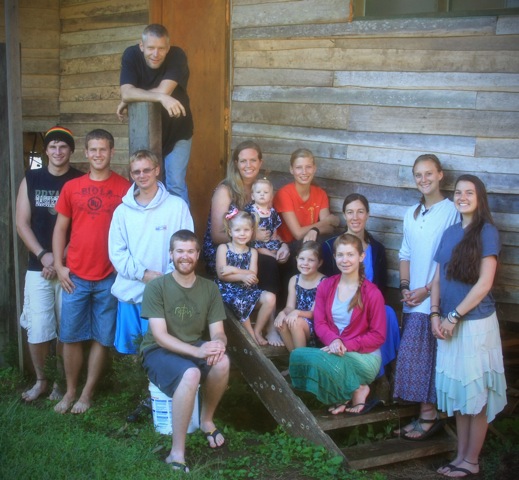
You may remember a couple months ago how Shannon and I had the opportunity to teach about bible translation and talk about life in the bush with some students in the 'Interface' program. We both really enjoyed the 'full circle' effect of having been through the Interface program ourselves more than 10 years ago and now being in a place to bless others who are similarly seeking God's will for their young lives, questioning whether God might be directing them to serve in an unreached tribal location on the other side of the world! We enjoyed being a part of that so much that we wanted more! So we invited a group of those students to make a side trip here into Mibu where they could experience tribal ministry happening.

These 3 young men and 4 young women (joined by the Devines, an NTM couple who came to provide food for everyone) were amazing! Watching them jump right in, unhesitatingly spending many long hours with the Mibu people, despite the HUGE cultural and linguistic gap, was such an encouragement to us! As they tried learning some little tidbits of the Mibu language and culture, and listened to different Mibu testimonials about God's work in their personal lives and the life of the community, and as they spent time visiting in their homes, gardens, village and surrounding areas, they formed relationships that served to encourage on all sides. For the Mibu people, they were more than a little excited to have the opportunity to encourage those to whom God may be directing toward serving in another tribal location who has yet to hear the gospel. For the students, seeing and hearing the Mibu believers spoke to the power of God's word in any culture or language. For us, seeing what may possibly be the next generation of young church planters excited and in awe of God's work here reminded us of ourselves just over 10 years ago when we were on an Interface side trip similar to this one.

We're so thankful to have had the honor of sharing this experience with these young folks this last week!